Learn Korean – Speak Daily Conversation (일상회화)
How to say: “Where are you going?” in Korean Language Hangukeo.

Learn Korean – Speak Daily Conversation (일상회화)
How to say: “Where are you going?” in Korean Language Hangukeo.
It’s the Korean writing system. It was created to make language learning simple and easy. And believe me, it is. Of course, being able to read in the same speed as a native Korean is something that’ll take you many, many years to achieve but learning Hangul is extremely easy. Especially if you compare it to Japanese for example, which uses three writing systems. 🙂
Unlike the romanization of the Japanese language, romanized Korean is often not a very good representation of how the words are pronounced. But if you can read hangul, you’ll know exactly how the words are pronounced since there are relatively few exceptions!
I created this program for you to learn Hangul just in 4 sessions! Try this first session with me and you’ll know how easy it is!

Korean Language Class Level: Beginner 1
Pre-requisite: None.
Class Schedule: Aug 30th, 2017.
Class Time: @ 8:10PM – 9PM PST (50 minutes)
Class Objective: We will cover the Korean alphabet (Hangul) – simple vowels and simple consonants. Emphasis is on skill building of the Hangul reading, writing, listening and pronunciation.
Course Method
Course Material
Attendance, Class size

Adults Class – Every Saturday @ 10:10AM PST (50 minutes session)
Korean Language Class Level: Beginner 1
Class Schedule: Sept 16 – Oct 7, 2017 (4 weeks)
Class Time: Every Saturday @ 10:10AM – 11AM PST
Pre-requisite: None.
| Feature of Beginner Level 1 Course |
| This course is designed for the 2nd or 3rd generation of Korean people living abroad and non-native Korean speakers who wants to learn Korean exactly same way how Korean learn their own language. The Beginner level 1 class meets once a week. This course introduces the foundation of the Korean language. Emphasis is on skill building of the Hangul reading, writing, listening and pronunciation. Upon completion, students are able to have a very basic knowledge of the language & understand familiar everyday expressions and very basic phrases. |
| How Beginner Level 1 course is composed? |
| This course is comprised of 16 chapters.In the 1st lesson, we will cover the Korean alphabet (Hangul) – simple vowels, simple consonants, and syllable formation.
In the 2nd lesson, we will cover the compound vowels 1 and 2. In the 3rd lesson, we will cover the double consonants, final consonants 1 and 2. In the 4th lesson, we will cover the main conversation and expressions including vocabulary, grammar, listening, speaking, and writing. |
Course Method
Course Material
Attendance, Class size, Make-up class
Registration

Korean Conversation 일상회화 : What are you up to this Saturday?
이번 토요일에 뭐해요?
ibeon toyoire mwo haeyo?


스펙 : The proof of various abilities which job seekers have
‘스펙’ is from the English word ‘spec’ which is the contraction of ‘specification’, and it means the characteristic, function or performance of a certain product. By the way, we began to use the word ‘스펙’ as the meaning of ‘취업을 위해 갖추고 있는 능력 (ability which is needed for finding a job), by comparing the job seekers to the products as if they are the products sold to the company. We often say ‘스펙이 좋다/나쁘다 (spec is good/bad)’or ‘스펙을 쌓다 (build a spec)’, and we use it for anything needed for finding a job such as in ‘스펙 관리 (spec management)’, ‘외모 스펙 (appearance spec)’ and ‘합격 스펙 (pass spec)’.
Lately, the word ‘스펙’ earned a negative meaning as people use ‘스펙’ for almost everything which would help with finding a job such as school ties, regionalism, blood ties and even appearance which does not have anything to do with ability or skill.
애를 먹다 (have a hard time (literally, ‘eat Ae’)) : have considerable difficulties and feel extremely tired.

From an old Korean saying, “애 (Ae)” literally means the “intestine”. Now, the word has come to mean “근심에 싸여 초조한 마음속 (one’s nervous mind that is filled with worries)” and “마음과 몸의 몹시 수고로움 (extremely tired mind and body)”. “애를 먹다 (to eat Ae)” means “to have considerable difficulties”, or simply put, “to do backbreaking work”. Because this expression is used when we arduously completed something uneasy, we need to clarify the reasons of eating Ae by using the following sentence structure: “-때문에 애를 먹다 (to eat Ae, because of something)”, “-느라 애를 먹다 (to eat Ae when doing something)”. However, these expressions with Ae are not used with the elderly.
엊그제 같은데 (It is just like yesterday) : This expression means that something which happened long time ago seems as if it just happened yesterday or the day before yesterday.
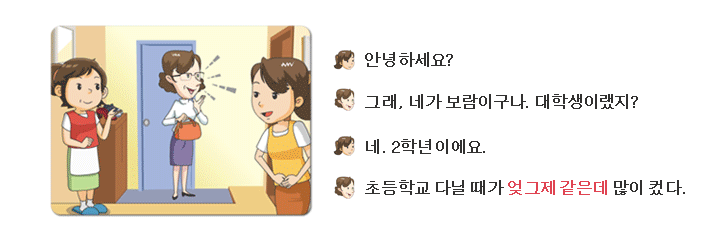
When we feel like time flies, we use the expression “엊그제 같은데 (it seems like yesterday or the day before yesterday)”. It means something that happened so long ago but it seems to you that it just happened yesterday or the day before yesterday. It has a nuance that you feel little bit sad or surprised for the days going so quickly without noticing it.

