Korean Conversation 일상회화 : What are you up to this Saturday?
이번 토요일에 뭐해요?
ibeon toyoire mwo haeyo?

Korean Conversation 일상회화 : What are you up to this Saturday?
이번 토요일에 뭐해요?
ibeon toyoire mwo haeyo?


만장일치 (consensus) is used when all the congregated people have the same opinion.
Meaning: 만 “be full of”, 장 “year”, 일 “one”, 치 “guide”
만장일치 (consensus) refers to a situation when all people gathered in a place are of the same opinion. When everybody agrees with an item, we say “만장일치 찬성 (a unanimous agreement)”, on the other hand, when everybody disagrees with an item, we say “만장일치 반대 (a unanimous disagreement)”. This word is often found in political systems or frameworks.

스펙 : The proof of various abilities which job seekers have
‘스펙’ is from the English word ‘spec’ which is the contraction of ‘specification’, and it means the characteristic, function or performance of a certain product. By the way, we began to use the word ‘스펙’ as the meaning of ‘취업을 위해 갖추고 있는 능력 (ability which is needed for finding a job), by comparing the job seekers to the products as if they are the products sold to the company. We often say ‘스펙이 좋다/나쁘다 (spec is good/bad)’or ‘스펙을 쌓다 (build a spec)’, and we use it for anything needed for finding a job such as in ‘스펙 관리 (spec management)’, ‘외모 스펙 (appearance spec)’ and ‘합격 스펙 (pass spec)’.
Lately, the word ‘스펙’ earned a negative meaning as people use ‘스펙’ for almost everything which would help with finding a job such as school ties, regionalism, blood ties and even appearance which does not have anything to do with ability or skill.
엊그제 같은데 (It is just like yesterday) : This expression means that something which happened long time ago seems as if it just happened yesterday or the day before yesterday.
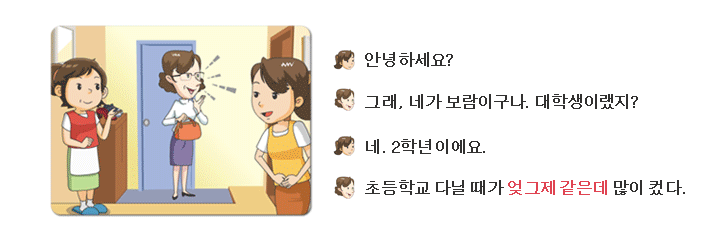
When we feel like time flies, we use the expression “엊그제 같은데 (it seems like yesterday or the day before yesterday)”. It means something that happened so long ago but it seems to you that it just happened yesterday or the day before yesterday. It has a nuance that you feel little bit sad or surprised for the days going so quickly without noticing it.

The Legend of the Blue Sea (푸른 바다의 전설)
조선 시대의 야담집인 “어우야담”에 나오는 인어 이야기를 모티브로 한 귀여운 드라마다! OST 또한 사랑스러운 린의 목소리가 너무나 잘 어울린다. 내일 8회가 너무나도 기다려 진다. 우리 학생들은 이번주부터 1회 시작이죠? 재미있게 보고, 드라마 리포트 기대 할께요~
문자 온 줄 몰랐어 (I didn’t notice that I got a text message) : This expression has the meaning that “이제서야 알았다 (I just noticed late)” rather than “몰랐다 (did not know).”

Just after realizing that you got a message, you can say “문자 온 줄 몰랐어 (I didn’t notice that I got a text message)”. As such, you can say “전화 온 줄 몰랐어 (I didn’t know I got a call)” and “메일 보낸 줄 몰랐어 (I didn’t know you sent me an email)” after noticing that you got an email or a call. This expression emphasizes the meaning, “이제서야 알았다 (I just noticed late) rather than “몰랐다 (did not know)”.

완소 (Wanso) : be completely precious
“완소” is an abbreviated form of “완전 소중하다 (완전 [completely] + 소중하다 [to be precious]). A few years ago, some Koreans started calling their favorite celebrities in TV series or movies as “완소”. However, just recently, “완소” is widely used not only for persons but also for certain items. “완전 [complete]” refers to “the condition that something is flawless and as great as it possibly can be”.
“완소” is usually followed by a noun such as “완소 아이템(my precious item)”, “완소남(my precious man)”, “완소녀(my precious lady)”, etc.
