Search

the Korean Tutor

Professional Korean Language Tutor | Korean Language Classes for Children & Adults | Korean Dialect Coach | Korean Script Translator | LOS ANGELES | NEW YORK | CHICAGO | HOUSTON | PHOENIX | PHILADELPHIA | SAN ANTONIO | SAN DIEGO | DALLAS | AUSTIN | SAN JOSE | SAN FRANCISCO | SEATTLE | WASHINGTON, D.C. | BOSTON | TORONTO | MONTREAL | VANCOUVER | SEOUL | TheKoreanTutor.com

Tag

한국어

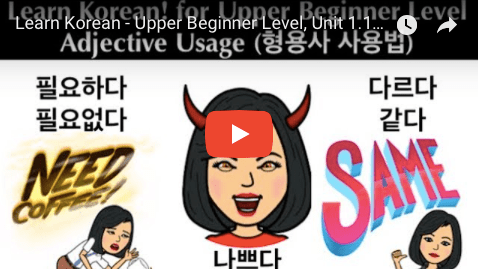
Upper Beginner Level, Unit 1: Adjective Usage (형용사 사용법)

Learn Korean – Upper Beginner Level, Unit 1: Adjective Usage (형용사 사용법)

Download a free PDF lesson for this episode here: UNIT 1

Screen Shot 2018-05-26 at 10.07.20 AM

시끄럽다 (To be loud): 시끄럽다 is a ᄇ irregular verb. The item, place, or person that is loud is marked with a topic or subject particle.

조용하다 (To be quiet): 조용하다 is a 하다 verb. The item, place, or person that is quiet is marked with a topic or subject particle.

길다 (To be long), 짧다 (To be short) The item that is long or short is marked with the subject particle 이/가 or topic particle 은/는. 짧다 ends with a ᄇ but it is not ᄇ irregular verb. 짧다 is not for height.

Korean Everyday Conversation: 다 와 가 (I am almost there)

Screen Shot 2018-04-26 at 8.55.38 AMScreen Shot 2018-04-26 at 8.56.16 AM

Korean Everyday Conversation (일상회화)

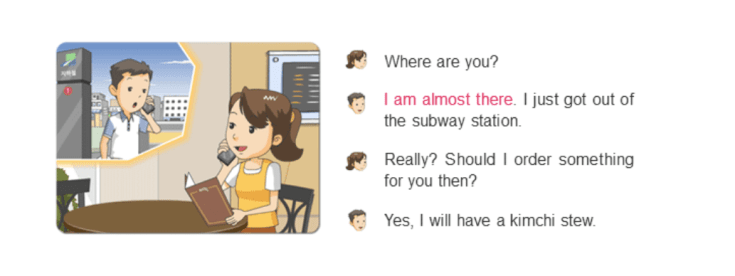
다 와 가 (I am almost there)

다 와 가 is used when we say that we almost arrived at the appointed place to the person who we are supposed to meet.  We normally use 가다 when we are moving towards the target place instead of 오다 which is used when someone is moving towards the speaker.  For example, if we are at school, we say 학교에 와 (come to school) or 집에 가 (go home) to the listener.  On the contrary, if we are home, we say 학교에 가 (go to school) or 집에 와 (come home).  However, you have to pay attention to the fact that we say 다 와 가 by using 오다  even though the speaker is moving towards the listener.


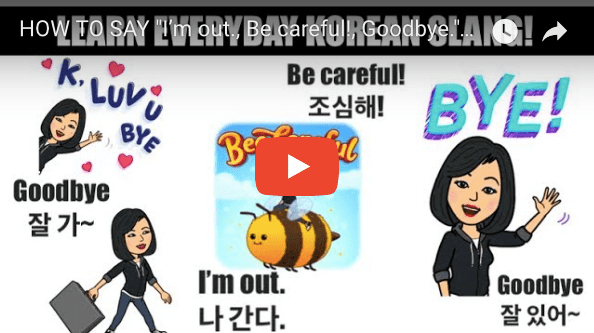
[Everyday Korean SLANG!] HOW TO SAY “I’m out., Be careful!, Goodbye.” IN KOREAN LANGUAGE.

[Everyday Korean SLANG!]
HOW TO SAY “I’m out., Be careful!, Goodbye.” IN KOREAN LANGUAGE

Screen Shot 2018-01-23 at 9.26.22 AM.png

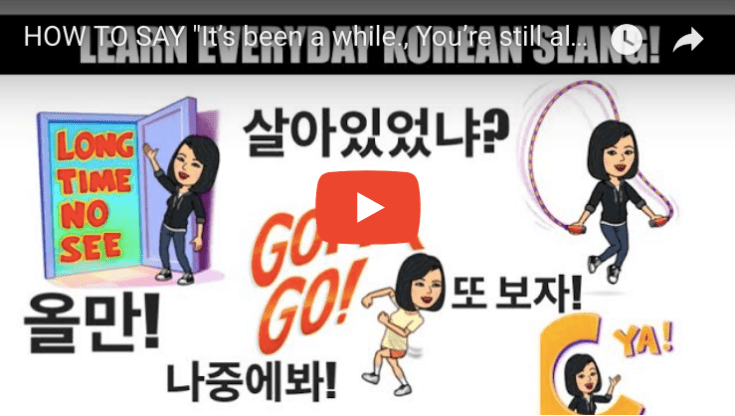
[Everyday Korean SLANG!] HOW TO SAY “It’s been a while., You’re still alive?, See ya!, Later!” IN KOREAN LANGUAGE.

[Everyday Korean SLANG!]
HOW TO SAY “It’s been a while., You’re still alive?, See ya!, Later!” IN KOREAN LANGUAGE.

Screen Shot 2018-01-22 at 11.25.46 AM.png

[Everyday Korean SLANG!] HOW TO SAY “How ya been?, Good!, So-so., Sucky.” IN KOREAN LANGUAGE.

[Everyday Korean SLANG!]
HOW TO SAY “How ya been?, Good!, So-so., Sucky.” IN KOREAN LANGUAGE.

Screen Shot 2018-01-20 at 10.33.23 AM.png

[Everyday Korean SLANG!] HOW TO SAY “Hi., Yo!, What’s up?, Whatcha been up to?” IN KOREAN.

[Everyday Korean SLANG!]
HOW TO SAY “Hi., Yo!, What’s up?, Whatcha been up to?” IN KOREAN.

Screen Shot 2018-01-19 at 8.59.10 PM.png

HOW TO SAY “Can we have another glass of water, please” IN KOREAN

HOW TO SAY “Can we have another glass of water, please” IN KOREAN

[Korean Singer/Actress: IU (Lee Ji-eun)]

Learn Korean Vocabulary:
여기=here
물=water
한 잔=one cup
+만=only
더=more
주세요=give(please)

Screen Shot 2017-11-14 at 10.34.32 AM.png

KOREAN URBAN DICTIONARY: HOW TO SAY “girl crush” IN KOREAN

KOREAN URBAN DICTIONARY
HOW TO SAY “girl crush” IN KOREAN: 걸크러시 (Lee Hyo-Ri)

Screen Shot 2017-11-12 at 9.38.39 AM.png

Learn Korean Vocabulary: Frequently

Learn Korean Vocabulary: Frequently = 자꾸만

[K-Pop TWICE(트와이스) “LIKEY”]

Screen Shot 2017-11-02 at 10.06.11 AM.png

Create a website or blog at WordPress.com

Up ↑