Search

the Korean Tutor

Professional Korean Language Tutor | Korean Language Classes for Children & Adults | Korean Dialect Coach | Korean Script Translator | LOS ANGELES | NEW YORK | CHICAGO | HOUSTON | PHOENIX | PHILADELPHIA | SAN ANTONIO | SAN DIEGO | DALLAS | AUSTIN | SAN JOSE | SAN FRANCISCO | SEATTLE | WASHINGTON, D.C. | BOSTON | TORONTO | MONTREAL | VANCOUVER | SEOUL | TheKoreanTutor.com

Tag

Lesson

Upper Beginner Level, Unit 2: Action Verbs Usage (동사 μ‚¬μš©λ²•)

Learn Korean – Upper Beginner Level, Unit 2: Action Verbs Usage (동사 μ‚¬μš©λ²•)

Download a free PDF lesson for this episode here:Β Unit 2

Screen Shot 2018-06-09 at 10.01.45 AM

ν•˜λ‹€ (to do): The thing you are doing is marked with the object particle 을/λ₯Ό.

μ’‹μ•„ν•˜λ‹€ (to like), μ‹«μ–΄ν•˜λ‹€ (to dislike): The person, thing, place that you like or dislike is marked with the object particle 을/λ₯Ό.

κ³΅λΆ€ν•˜λ‹€ (to study): The thing being studied is marked with 을/λ₯Ό object particle. The place where you study is marked with the event/activity location particle μ—μ„œ.

Upper Beginner Level, Unit 1.1: Adjective Usage (ν˜•μš©μ‚¬ μ‚¬μš©λ²•)

Learn Korean – Upper Beginner Level, Unit 1.1: Adjective Usage (ν˜•μš©μ‚¬ μ‚¬μš©λ²•)

Download a free PDF lesson for this episode here:Β Unit 1.1

Screen Shot 2018-06-05 at 1.37.15 PM.png

λ‹€λ₯΄λ‹€ (To be different), κ°™λ‹€ (To be the same): λ‹€λ₯΄λ‹€ and κ°™λ‹€ are used to compare one or more items. The item being compared is marked with any of the three β€œAND” conjunctive words such as 와/κ³Ό, ν•˜κ³ , λž‘/μ΄λž‘.

ν•„μš”ν•˜λ‹€ (To need), ν•„μš”μ—†λ‹€ (To not need): The thing that is needed or not needed is marked with a topic or subject particle.

λ‚˜μ˜λ‹€ (To be bad): The item, place, or person that is bad is marked with a topic or subject particle.

Upper Beginner Level, Unit 1: Adjective Usage (ν˜•μš©μ‚¬ μ‚¬μš©λ²•)

Learn Korean – Upper Beginner Level, Unit 1: Adjective Usage (ν˜•μš©μ‚¬ μ‚¬μš©λ²•)

Download a free PDF lesson for this episode here:Β UNIT 1

Screen Shot 2018-05-26 at 10.07.20 AM

μ‹œλ„λŸ½λ‹€ (To be loud): μ‹œλ„λŸ½λ‹€ is a ᄇ irregular verb. The item, place, or person that is loud is marked with a topic or subject particle.

μ‘°μš©ν•˜λ‹€ (To be quiet): μ‘°μš©ν•˜λ‹€ is a ν•˜λ‹€ verb. The item, place, or person that is quiet is marked with a topic or subject particle.

κΈΈλ‹€ (To be long), μ§§λ‹€ (To be short) The item that is long or short is marked with the subject particle 이/κ°€ or topic particle 은/λŠ”. μ§§λ‹€ ends with a ᄇ but it is not ᄇ irregular verb. μ§§λ‹€ is not for height.

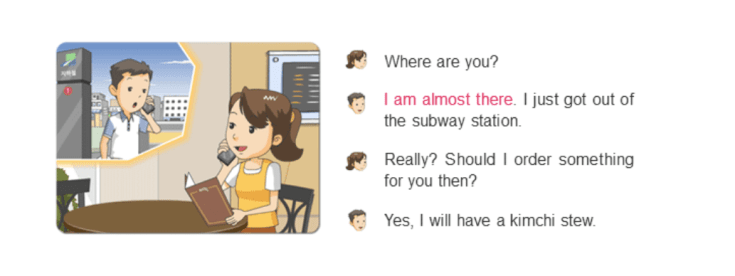
Korean Everyday Conversation: λ‹€ 와 κ°€ (I am almost there)

Screen Shot 2018-04-26 at 8.55.38 AMScreen Shot 2018-04-26 at 8.56.16 AM

Korean Everyday Conversation (μΌμƒνšŒν™”)

λ‹€ 와 κ°€ (I am almost there)

λ‹€ 와 κ°€ is used when we say that we almost arrived at the appointed place to the person who we are supposed to meet.Β  We normally use κ°€λ‹€ when we are moving towards the target place instead of μ˜€λ‹€ which is used when someone is moving towards the speaker.Β  For example, if we are at school, we say 학ꡐ에 와 (come to school) or 집에 κ°€ (go home) to the listener.Β  On the contrary, if we are home, we say 학ꡐ에 κ°€ (go to school) or 집에 와 (come home).Β  However, you have to pay attention to the fact that we sayΒ λ‹€ 와 κ°€ by using μ˜€λ‹€Β  even though the speaker is moving towards the listener.


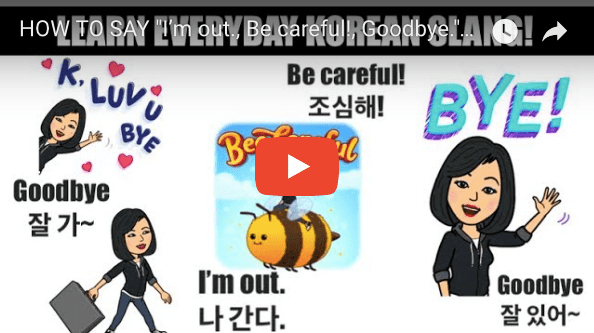
[Everyday Korean SLANG!] HOW TO SAY “I’m out., Be careful!, Goodbye.” IN KOREAN LANGUAGE.

[Everyday Korean SLANG!]
HOW TO SAY “I’m out., Be careful!, Goodbye.” IN KOREAN LANGUAGE

Screen Shot 2018-01-23 at 9.26.22 AM.png

[Everyday Korean SLANG!] HOW TO SAY “It’s been a while., You’re still alive?, See ya!, Later!” IN KOREAN LANGUAGE.

[Everyday Korean SLANG!]
HOW TO SAY “It’s been a while., You’re still alive?, See ya!, Later!” IN KOREAN LANGUAGE.

Screen Shot 2018-01-22 at 11.25.46 AM.png

[Everyday Korean SLANG!] HOW TO SAY “How ya been?, Good!, So-so., Sucky.” IN KOREAN LANGUAGE.

[Everyday Korean SLANG!]
HOW TO SAY “How ya been?, Good!, So-so., Sucky.” IN KOREAN LANGUAGE.

Screen Shot 2018-01-20 at 10.33.23 AM.png

[Everyday Korean SLANG!] HOW TO SAY “Hi., Yo!, What’s up?, Whatcha been up to?” IN KOREAN.

[Everyday Korean SLANG!]
HOW TO SAY “Hi., Yo!, What’s up?, Whatcha been up to?” IN KOREAN.

Screen Shot 2018-01-19 at 8.59.10 PM.png

[Everyday Korean SLANG!] – a good meal λ§›μžˆλŠ” μŒμ‹

[Everyday Korean SLANG!] – a good meal λ§›μžˆλŠ” μŒμ‹
HOW TO SAY Delicious!, It melts in my mouth., It’s sweet and spicy., It warms up my body (hot soup) in KOREAN.

Screen Shot 2017-11-22 at 9.24.12 AM.png

Create a website or blog at WordPress.com

Up ↑