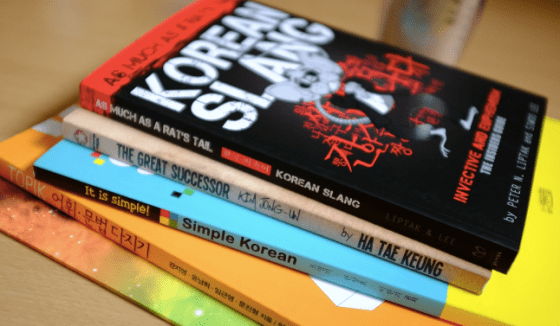
The 10 Best Korean Books for Korean Language Students
Why Reading Textbooks Can Help You Learn Korean
Here are a few reasons why it’s worth checking out Textbooks.
A Good Textbook:
- Provides you with a framework for learning.
- Helps you be familiar with Hangul.
- Teaches you the basics in pronunciation.
- Follows your desired pace in learning.
Reading a book may sound like a waste of time??? It’s too academic, too high-brow, when you only wanted to communicate like a modern day native speaker.
Sounds intuitive, doesn’t it? You just wanted to speak, so you practiced speaking. Unfortunately, common sense works against you in this case. Because, get this: if you want to speak right, you’re gonna have to do a lot of reading in your target language. Language acquisition requires you to connect the dots. “Listening” is just one of the dots. “Getting the context right” is one of the dots. “Imitating the native speakers” is one of the dots. “Reading,” sure enough, is also one of the dots.
So if you really want to learn a new language fast, then you better get on the couch and read! You have no idea how limited the speech-centric approach to learning a language really is. Here are some major reasons why reading books is the best way to go:
- You need to learn the rules first. You can’t play around with a language (like everyday people do) until you learn the rules of grammar and style. Native speakers understandably take these rules for granted, or aren’t even aware that they exist! You listen to a native and what you hear are the grammar rules mangled in almost every way possible. You hear the richness of the language as exemplified by the exception to the grammar rules. The problem is, you won’t grasp any language just by learning about the exceptions! You first need to look into the underlying language principles that they break. Then you can practice breaking them just like any native speaker. Only then will you truly appreciate the language.
- The brain is able to remember more when it sees things. Learning is facilitated by visual cues, and reading helps the brain remember by showing it the words and the pictures that the word represents.
- Books contain a richer language. The speech-centric approach is inscrutably vague. Compared to the written word, the spoken word is very ambiguous. Average speakers don’t spend as much time choosing their words as writers do. So there is very little nuance in the spoken language.
- Attack the language on all fronts. If you really want to learn a language fast, you need to attack it in every way possible. Confining yourself to a single learning source, you won’t be able to connect the dots and make out the big picture. You need to read, you need to talk to natives, you need to experience the language in all its facets.
Tips on Learning Korean Through Textbooks
Now that we’ve set those fears aside, here are a few more tips you have to keep in mind.
- Follow the sequence. I’m sure some of you would want to skip the primary lessons and go straight to phrases that you can use in your business or in your travels. Don’t. You’ll find it harder to understand. It’s best to start with the basics. Follow the flow of the textbooks. These are written in the way to help you out. The essential vocabularies are slowly introduced to you and most books will use them again and again so you can clearly remember them. So don’t skip the lessons. Don’t jump to the middle.
- Do the exercises. Most textbooks have accompanying workbooks. Some have exercises at the end of the chapters. Make sure you do them. Don’t think that as long as you browse the lessons, you’ll easily remember the way the syllables are written. That’s not true.
- Practice. Once you’ve mastered the basics, take time to use what you’ve learned in your everyday life. This will help motivate you to learn more. Once you see its practicality and the fact that you can now inject Korean phrases into your daily life, you’ll want to keep learning and keep practicing.
- Learn 5 words a day. Take it slow until you get it. Learning is never done overnight. You’ll remember the words better when you learn a few words a day. You’ll get to understand them more.
Alright, perhaps the above tips confirm everything that you’ve been dreading. Learning Korean will still take a lot of work.
If it makes you want to throw your hands up, there’s also another option: Take your first session with me. Book your session today! I will create a customized approach tailored specifically for your needs.
All in all, my lesson provides high quality learning experience with online learning system. I have developed the best solution for everyone to learn Korean easier and faster with my program. You can be fluent in Korean and I will do my best efforts to guide you through the process. Talk about killing two birds with one stone!
Feel Free to Share with Your Family and Friends: